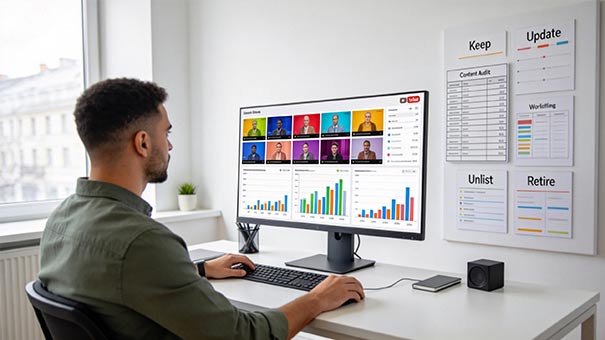
How to Build a YouTube Video Library That Keeps Earning Over Time


Utility Box
Article type: Evergreen editorial strategy guide
Primary use: Building a YouTube back catalog that can support steadier long-term revenue without depending on one-off spikes
Best for: Educational, review, tutorial, commentary, and decision-help channels
Not mainly for: Channels built almost entirely on novelty, spectacle, or short-lived trend spikes
Core idea: A revenue-supporting video library is not just a group of monetized uploads. It is a structured archive in which discovery, trust, decision support, and maintenance reinforce one another over time.
What this article does not do: It does not promise YouTube Partner Program access, ad performance, affiliate income, or channel growth.
About the author
Skylar Sun writes about YouTube monetization structure, creator publishing systems, and the editorial decisions that shape long-term channel value. This site’s analysis focuses on how creators build useful content libraries, interpret platform guidance, and make monetization choices without relying on shortcuts or formula-driven advice.
Where relevant, articles are reviewed against current public documentation from YouTube and Google. Where the argument goes beyond official rules, it is presented as editorial judgment based on repeat patterns visible across creator workflows, video libraries, and monetization-oriented publishing decisions.
This website is not affiliated with YouTube or Google.
A lot of YouTube advice is built around the wrong unit of thinking.
It treats a channel as a sequence of uploads and success as a matter of finding the next hit. That can produce occasional spikes, but it does not explain why some channels keep earning from older videos long after the attention around a new upload has faded.
A stronger model is to think in terms of a library. Over time, revenue tends to hold up better when a creator publishes around a repeatable viewer need, creates clear entry points, builds useful depth, and monetizes only where that fit is natural.
Some videos bring in new viewers. Some make the creator’s judgment easier to trust. Some help viewers compare, choose, or act. Some keep older content useful instead of letting it decay.
The harder part is that the videos drawing first attention are often not the ones that later support the most reliable revenue.
Who This Article Is / Is Not For
This article is for creators building a serious channel around a recognizable type of value: tutorials, explainers, software walkthroughs, practical commentary, product comparisons, hobby instruction, research-led analysis, or other formats where the audience returns for clearer decisions and better understanding.
It is especially relevant if your viewers are asking questions such as:
- Where should I begin?
- What should I watch next?
- Which version or tool makes more sense?
- What changes after I know the basics?
- What mistake will waste my time or money?
Those questions are a strong sign that a library model can work. They suggest that viewers do not just want isolated answers. They want guidance through a sequence.
This article is not mainly for channels built almost entirely on spectacle, personality-driven novelty, or fast-moving timing windows. Those channels can still benefit from library thinking, but their results are often less stable and more dependent on momentum.
It is also not a shortcut guide. Access to monetization features through the YouTube Partner Program matters, but eligibility opens access to monetization. It does not create a durable library by itself.
Why Most Advice on This Topic Stays Too Thin
Most articles about “money-making videos” give familiar advice: make evergreen content, use searchable titles, stay consistent, build playlists, add affiliate links, and review analytics.
The problem is not the advice itself, but the lack of structure behind it.
Those tactics become useful only when they support different jobs inside one archive. A library that keeps earning usually performs four jobs somewhere inside the catalog:
- Discovery: giving the right new viewer a clear entry point
- Trust: proving that the creator can explain, evaluate, or solve something well
- Decision support: helping the viewer choose, compare, avoid mistakes, or move forward with more confidence
- Maintenance: keeping strong older videos useful enough to remain part of the channel’s value
If one or more of those jobs are missing, the back catalog often stays weaker than it looks. A channel may still get views. It may even have strong uploads from time to time. But the overall archive does not become especially dependable.
One of the most useful corrections here is simple: the videos that first grow a channel are often not the same videos that later stabilize its revenue.
That is why so many creators misread their own progress. They assume the broadest or most visible video is the main economic engine of the channel when, in practice, deeper and quieter parts of the archive may matter more.
What a Real Earning Library Actually Does
A working library usually contains four layers. Thinking in layers is more useful than thinking in disconnected ideas.
Discovery layer
Discovery videos help the right viewer enter the channel.
These are often beginner explainers, setup guides, definitions, introductions, or narrow tutorials built around an obvious question. Their job is not to say everything. Their job is to make the first “yes” easy. The viewer should quickly understand what problem is being solved and why this creator is worth listening to.
Good discovery content is usually specific enough to be found, but broad enough to introduce a wider part of the channel.
Trust layer
Trust grows when the viewer sees judgment, not just information.
This layer often includes troubleshooting videos, workflow explanations, side-by-side comparisons, “what changed after using this for a month” reflections, and careful mistake-avoidance pieces. Viewers do not return to creators only because facts were presented clearly. They return because the creator seems capable of distinguishing what matters from what does not.
That distinction is especially important in crowded niches, where basic information is abundant but editorial judgment remains scarce.
Decision support layer
This layer helps viewers compare options, understand trade-offs, avoid a bad setup, or decide whether a change is worth making.
That is also why some videos create more revenue opportunities than others. The difference is usually not aggressiveness. It is timing. When a viewer is already trying to choose, a relevant link, resource, or recommendation can fit without changing the tone of the video.
Maintenance layer
Maintenance is what keeps a useful archive from quietly becoming less useful.
Software changes. Product pages disappear. Links break. Interfaces shift. Pricing models move. Advice that was accurate eighteen months ago can become incomplete long before the creator notices.
That is why strong libraries are not simply published. They are maintained. Sometimes that means updating descriptions, pinned comments, or related links. Sometimes it means recording a follow-up, revising a title to match the current use case more accurately, or creating a newer entry point that routes viewers into older videos which still hold up.
Maintenance rarely looks exciting from the outside, but it protects trust and extends the useful life of the archive.
Start With Viewer Need, Not Topic Buckets
Many creators think they have a niche when they actually have a loose collection of adjacent subjects.
A niche becomes stronger when it is built around a repeatable type of need rather than a broad category word.
“Productivity” is broad. “Productivity systems for students balancing several deadlines” is a clearer need. “Gaming” is broad. “Performance settings and setup decisions for players on low-end hardware” is a clearer need. “Camera reviews” is broad. “What camera setup makes sense for solo creators filming indoors” is a clearer need.
This matters because a need produces a natural content sequence. Once the channel is built around a repeatable kind of friction, ideas begin connecting more easily. Entry videos answer the first question. Trust videos make the creator’s judgment visible. Decision-support videos narrow choices. Maintenance keeps the archive from losing value.
A common mistake appears early: creators build too much middle depth before they have enough entry points. Ten advanced uploads do not create a strong library if new viewers still cannot tell where to begin.
A more reliable sequence usually looks like this:
- create a clear starting-point video
- add one or two logical follow-ups
- publish at least one video that helps with comparison or choice
- notice where viewers become confused or stalled
- build the next branch from that friction point
That is how a library starts becoming easier to enter and easier to follow.
Build Evergreen First, Then Add Trend-Aware Entries
Evergreen content usually forms the backbone of a durable library because its usefulness lasts longer. That does not mean it never ages. It means it often stays relevant for longer than trend-driven content, which gives the creator more time to benefit from search, recommendations, and repeat viewing.
The most dependable evergreen videos usually do one of three things:
- teach a stable concept
- solve a recurring problem
- explain a durable decision
Trend-aware content still matters. It can widen discovery, attract first-time viewers, and signal that the creator is active in the current conversation. But trend-aware videos work best when they connect back into a stronger archive.
Without that connection, they tend to produce attention without continuity. With that connection, they can become useful entry points that pull new viewers toward more durable content.
The real question is not whether trend-aware content works. It is whether it strengthens the library or pulls attention away from it.
Make Videos Easy to Find, but Do Not Build Around Keywords Alone
Discoverability matters, but a channel built only around keyword logic often becomes flatter than it should be.
A strong library usually makes several simple choices well. Titles reflect the real question the viewer is asking. Descriptions clarify what the video actually helps with. Thumbnail language stays recognizable enough that viewers can understand the channel’s style of help at a glance. Packaging is precise without becoming mechanical.
If a creator has access to YouTube’s official A/B testing for titles and thumbnails, that feature can help improve packaging. So can YouTube’s own thumbnail and title guidance.
But packaging is only one part of a library. A title earns the click; the opening has to confirm the match. If the viewer arrives expecting one kind of help and receives a different one, the archive becomes harder to trust even when the click-through rate looks respectable.
A useful library is not only searchable. It is easy to understand on first contact.
Design Pathways, Not Isolated Hits
The difference between a working library and a loose archive becomes especially visible after the first strong entry video appears.
If that video does not lead to the next useful step, the channel usually wastes momentum.
This is where routing matters. Playlists should reflect a real viewing order rather than a generic subject label. Pinned comments should give viewers a concrete reason to continue. Descriptions should support progression where relevant rather than functioning as a dumping ground for unrelated links. YouTube’s official tools, including end screens and cards, can help move viewers from introduction to depth, or from diagnosis to solution.
The point is not to link everything to everything else. It is to make the archive easier to travel without creating clutter.
A beginner guide may lead naturally into a first practical setup. A comparison video may lead into implementation or troubleshooting. A trend-aware update may lead back to the strongest evergreen explainer that gives the viewer a stable foundation.
Channels often miss this because they treat routing as decoration. In reality, it determines whether a good first click turns into a second useful one.
Use Revenue Layers Carefully
This is where many otherwise sensible monetization articles start sounding weak.
They assume every useful video should include a monetization layer: an affiliate link, a digital product mention, an email capture, a sponsorship cue, or some other revenue mechanism. That way of thinking usually makes the archive feel over-designed.
A better standard is simpler: add a revenue layer only when the viewer would reasonably expect that kind of help.
If the video compares tools, a relevant product link may make sense. If the audience repeatedly asks for the exact checklist or template used in the workflow, a practical resource may make sense. If the video solves one small problem cleanly, pushing a large paid offer may feel disproportionate.
The better question is not, “How do I monetize this video?” It is, “What kind of help would feel natural in this viewing context?”
That question matters because forced monetization weakens trust faster than many creators expect. Even inside the YouTube partner earnings overview, monetization is broader than a single ad result. But broader monetization options do not eliminate the need for keeping the format proportional to the viewer’s need.
Read Analytics Like an Editor, Not a Gambler
Once a creator has a meaningful archive, analytics become more useful, but only if they are read with the right frame.
Do not just ask which video got the most views. Ask which video did the most work.
Some videos bring in new viewers. Some increase repeat viewing. Some sit in the middle of an effective playlist. Some carry more ad value. Some quietly support affiliate clicks because the viewer is already comparing options. Some bridge first contact and deeper channel trust.
One recurring pattern is that creators often overvalue their broadest videos and undervalue the calmer videos that help viewers choose, set up, compare, or avoid mistakes. Those quieter videos often matter more to the overall system than they first appear to.
This is one reason analytics can mislead when read only for excitement. A visible spike is not always the same thing as a useful foundation.
An Editorially Anonymized Case Pattern
Consider a small creator library in software education.
The channel’s most visible videos were broad beginner explainers. They brought in most first-time viewers and produced the clearest early spikes, so the creator initially treated them as the channel’s main winners.
Later, a different pattern became harder to ignore. A smaller set of comparison and troubleshooting videos began doing more of the channel’s practical revenue work. They were not always traffic leaders, but the viewing context was different. People arriving there were often trying to choose between tools, fix a specific problem, or decide whether a change was worth the effort. That made those videos more naturally aligned with setup walkthroughs, workflow examples, and tool-specific follow-ups.
The lesson was not that beginner videos mattered less. It was that discovery and revenue concentration were happening in different parts of the library. Once the creator saw that clearly, the publishing strategy changed. Broad explainers still mattered, but they no longer carried the whole strategic weight. The real improvement came from building better routes from entry-level content into decision and workflow depth.
This is not an official YouTube rule. It is an editorial pattern. But it explains why channels that look similar from the outside can produce very different long-term results once the archive starts doing more than one job.
Decision Framework by Stage
Use this framework when deciding what to publish next.
Stage 1: Not enough entry points
Create videos with obvious beginner relevance and clear search value. Solve one problem per video. Keep the promise narrow. The main task here is to become easier to enter.
Stage 2: Viewers arrive but do not stay
Strengthen the trust layer. Publish troubleshooting content, comparisons, “what changed” explanations, or clearer workflow pieces. The main task here is to make judgment visible, not just information available.
Stage 3: The channel is useful, but revenue is thin
Publish more decision-support content: comparisons, setup choices, buying mistakes, tool trade-offs, or implementation decisions. The main task is to meet a more decision-rich need without forcing the sell.
Stage 4: Strong videos exist, but the archive feels messy
Review playlists, end screens, pinned comments, descriptions, and older entry points. Remove weak routing. Fix dead or stale links. The main task is to make the archive easier to navigate.
Stage 5: The library earns, but growth feels uneven
Review which videos attract viewers, which deepen trust, which support decisions, and which need maintenance. Then strengthen the weakest layer in the system rather than chasing whatever idea feels most exciting in the moment.
What NOT To Do / Common Mistake
The most common mistake is treating every useful video as if it deserves the same monetization behavior.
Creators add product mentions too early. They build large paid offers before enough trust exists. They chase broad views while neglecting quieter videos that actually help viewers move forward. They keep publishing new topics while older high-potential videos lose usefulness through neglect.
Another mistake is confusing topical consistency with library structure. A channel can publish fifty videos on one subject and still feel badly organized.
Repetition is not architecture.
A Copyable Reality Check
Copy this before publishing your next library-building video:
This video does not need to be a hit. It needs to do one job clearly and well.
Which job is it doing?
- bringing in the right viewer
- making my judgment easier to trust
- helping the viewer compare, choose, or move forward
- keeping an older part of the archive useful
If I cannot answer that clearly, the upload may be adding volume without adding structure.
FAQ
Do I need a large number of videos before a library can start earning?
No. A small archive can start helping if viewers can enter it easily and find a clear next step. Count matters less than connection.
Should every evergreen video include affiliate links or a product mention?
No. Add those only when the viewer is already expecting comparison, recommendation, or resource-level help.
Are trending videos bad for a long-term library?
No. They become a problem only when they bring attention that has nowhere useful to go.
What usually earns better: broad beginner content or more specific comparison and decision-support content?
They usually do different jobs, so the useful question is which role each one is playing.
Is this mainly about ad revenue?
No. It is about building a back catalog that can support several forms of channel value over time. Ads are only one layer.
Next Steps / Related Content
If you want to apply this framework immediately, start here:
- List your current videos and label each one as discovery, trust, decision support, or maintenance.
- Identify the strongest entry point in your archive.
- Decide what should follow that video.
- Check whether that follow-up already exists. If it does not, make it.
- Review older strong videos for stale examples, weak descriptions, dead links, or poor routing.
- Remove or soften monetization elements that feel out of proportion to the format.
- Publish the next video that fixes the clearest gap in the archive.
Natural follow-up topics after this article include:
- how to mix evergreen and trend-aware uploads without weakening channel identity
- why some YouTube videos with fewer views can still produce more revenue
- how playlists, end screens, and pinned comments influence channel structure
- when affiliate recommendations strengthen a channel and when they weaken trust
Why You Can Trust This Article
This article is written as an editorial analysis, not a guarantee-driven monetization pitch.
Where platform rules or product features are relevant, the article points readers to public documentation from YouTube or Google. Where the argument moves beyond official guidance, it is framed as editorial judgment based on repeat patterns visible across creator publishing workflows, video libraries, viewer-intent patterns, and monetization-oriented channel structure.
It does not assume that every channel monetizes in the same way, and it does not treat monetization access as proof of long-term revenue strength.
How This Article Was Reviewed
This article was reviewed against current public guidance from YouTube and Google where it touches platform access, monetization scope, content tools, and content quality principles, including the YouTube Partner Program overview, partner earnings overview, end screens help, cards help, title and thumbnail testing documentation, advertiser-friendly content guidance, and Google’s people-first content guidance.
Those sources help define the platform-facing boundaries: access to monetization is not the same as durable revenue structure, product tools do not replace editorial judgment, and monetization should not be described as guaranteed or formulaic.
Where this article makes broader claims about library design, viewer pathways, trust depth, or revenue concentration, those points are presented as editorial interpretation rather than official platform promises.
What This Article Does Not Claim
This article does not claim that:
- a larger library automatically means higher income
- every evergreen topic is commercially strong
- every channel should use affiliate links, digital products, or sponsorships
- broad videos are economically useless
- small channels cannot build meaningful revenue structure
- YPP access and long-term library economics are the same thing
The narrower claim is simple: strong videos should lead naturally to the next useful step, and monetization should appear where it fits.